
deepening solidarity practice, building collective power.
Our social movements often suffer from fragmentation – dissonance and disconnection that undermine our strategic effectiveness and damage groups and individuals. The need to build more cohesive strategies and movements, and exemplify the values we strive for in our work, is ever present. Yet we face deep challenges when we try to deconstruct and unlearn the ways we have been socialised into interlocking systems of oppression and understand and notice how these are being reproduced in our organising. This training aims to help us explore those challenges and to develop practices and strategies to build social movements capable of embodying active solidarity, mutual empowerment and collective power.
This course is for people who already have some grounding in power and privilege work at the individual, interpersonal and group levels, and want to build on that experience to apply it at an inter-organisational and movement levels.
In aiming to create social movements capable of building collective power and catalysing transformative systemic change, we are required to engage with themes of power, social positionality and the impacts of systemic oppression on individuals, groups and movements. This training offers a reflective space for exploring the challenges involved in grappling with systems of oppression at a movement, alliance and inter-organisational level, beginning to design and develop approaches for responding to them.
There are no ready-made or short-term solutions for embodying solidarity or intersectional organising effectively. The training is designed to create space for deep reflection, identifying challenges and unhelpful organising patterns that we encounter in our work and supporting us to develop capacities for responding that are context relevant, sensitive, adaptive and genuinely applicable and useful. This means being able to respond to the specifics of different movement building cultures in ways that feel empowering to the current context and with the communities and individuals involved.
We aim to collectively create a courageous and caring space, one that can enable us to step out of our comfort zones and what we already know, and enable critical reflection on movement practices and cultures – deepening awareness, interrogating habits, and exploring new and fresh possibilities and perspectives with the support of our peers.
We will explore the relationship between organising rooted in active and intentional solidarity, and the making of stronger movements – unpicking some of the conditions for resilience, effectiveness and flourishing. We will address experiences of practising intersectionality from cultures of fear, shame and blame, and possibilities for aligning with motivations of value-based togetherness and vision for justice and joy. We will look to approach the challenges with fresh eyes and supported reflexivity.
The training is based on Ulex’s Active Solidarity approach, which you can read here. It assumes a basic literacy with power and privilege themes.
Key topics will include:
Main methods and approaches:
Who is it aimed at?
Anyone with substantial experience in socially engaged action addressing ecological, political and social justice issues. We embrace a broad definition of activism that includes any form of contribution to change and social and ecological justice. That might include: Resistance – action preventing further damage to ecosystems and social justice; Renewal – action focused on developing and creating alternatives for healthier societies and communities; and Building Resilience – action supporting increased resilience in communities to weather the uncertain times ahead.
You will need a basic literacy with power and privilege themes to be able to participate in this course, alongside experience of organising in social movements. This course is not suitable for those just starting their engagement with social movements and looking for an entry-level course on power, privilege and oppression.
Attendance in online preparatory sessions and preparatory reading will be required to participate in the course.
The main spoken language on the course will be English.
For accessibility and venue information see here.
In the solidarity economy:
(See details of our approach to radical economics here)
Contact us
to apply

Location:
Jana is a facilitator, activist and organiser dedicated to creating transformative learning spaces and building capacity to collaboratively strategise for system change. With a background in education, she has a passion for critical and experiential pedagogy and research interest in how social movements learn and engage in counter-hegemonic knowledge production. Organising in different networks across the Netherlands, Spain, Belgium, the UK, and Germany, she is an adventurer of coalition building and practioner of transnational activism. Drawing from experience in the social and climate justice movement, she recently coordinated the programme for People’s Summit with the COP26Coalition and now works with European Alternatives and the School of Transnational Organizing. Keeping it up with the grassroots; Berlin based.

Location:
Binta wears many hats – educator, facilitator, organizer, activist, social entrepreneur, and mental health advocate – in support of community-led initiatives focused on social and climate justice. She has 10+ years experience working internationally on issues related to digital literacy, educational, social, and economic inclusion of marginalized communities, capacity and community building, and intercultural communication. In addition to organizing and working with anti-racist and feminist organizations in France, her current work focuses on helping movements structure and grow their impact, training youth leaders and activists in campaigning, community building and mobilization, and building networks of peer learning, support, and empowerment for marginalized communities.

Location:
Ilaj’s background is in grassroots organising, involving them in various strands of social movement work for nearly two decades, mostly in Eastern and Southern Europe. In more recent years, they have turned their attention to broader European movement building as part of the Ulex core team, where they design programmes, coordinate training teams and facilitate on a wide range of training courses. Ilaj is an experienced trainer with a broad range of skills, particularly in holding space for collective exploration of burnout, weathering repression, navigating trauma and cultivating solidarity in social movements. They are passionate about working with body awareness as a radical means of deconstructing internalised systems of oppression. They have been exploring the intersection between transformative somatics and political organising for a number of years.
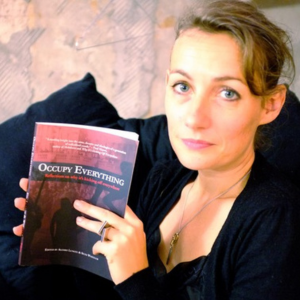
Location:
Isa (she/her) is an educator, facilitator, and author. She grew up in France before setting off on an adventure to London, where she worked as a freelance journalist, French teacher, and administrator for a community arts organisation, all while writing her PhD on the concept of community. She became Senior Lecturer in Media and Cultural Studies at Birkbeck College, University of London (UK), where she taught for 10 years before leaving academia to breathe the air of freedom and collective action. She co-founded and co-facilitates, with Jay Jordan, the Laboratory of Insurrectionary Imagination, which has been bringing together artists and activists since 2004 to co-design and implement creative forms of direct action that are as joyful as they are politically effective. Active in social movements for over 20 years, she has facilitated assemblies of several hundred people, co-organised international mobilisations and climate camps, and trained thousands of people in reinventing forms of civil disobedience. Her passion is exploring collective dynamics and all the ways in which these can be made more fruitful, joyful, and caring, particularly through popular education and rituals. She has been involved with the zad in Notre Dame des Landes since 2016.
Location:
An Maeyens (she/her) is a facilitator and trainer with over two decades of experience in grassroots movements. She specialises in creative, inclusive agenda design and brings deep expertise on group culture, power dynamics, and transformative learning. Starting of in the anti-globalisation movement she has trained thousands in civil disobedience, supported international coalitions, and developed multilingual training programmes and toolkits. Her work spans movements, cultures, and countries, guided by a commitment to care, accessibility, and leaderful organising.

Location:
Ari’s activism began in 2002, at age 16, as a Bosnian refugee in Canada, where they founded and coordinated a group for LGBTIQ high school students and allies. They were a co-founder and leader at kolekTIRV in Croatia and Trans Network Balkan, involved in community organizing, advocacy, program management, team coordination, capacity building, education, media work, campaigns, events, fundraising, etc. In 2024, they joined the Supervisory Board of the Croatian Trade Union Collective of United Precarious Workers and Activists (SKUPA).
Beyond the Balkan region, Ari served as a Board member at Transgender Europe (TGEU), where they held roles as Secretary, Treasurer, and later Co-chair. They have also been a trainer with the Center for Artistic Activism and served on the Advisory Committee and since 2022 as a Community Care Facilitator at FRIDA — The Young Feminist Fund. Since 2024 they are the Operations Manager at Global Philanthropy Project.
Location:
Sergio (all pronouns) was born in Romania and migrated to Germany in the early 2010s. In the past, he was a social worker with homeless people and a social consultant for Eastern European migrants for various organisations. Trained as a filmmaker, he spent two years making a documentary about the ‘civic reawakening’ in Romania and the waves of protest it brought with it. In connection to this, Sergio is currently co-steering the development of an online open-source participative knowledge production platform on activism in Romania. Over the past nine years, Sergiu has offered his skills to various journalists, grassroots collectives and campaigns, mostly working within the labour rights, climate justice, international solidarity and anti-authoritarian movements in Germany and Romania. Nonetheless, his biggest focus since 2020 has been his work as an organiser with the anarcho-syndicalist Free Workers Union, where he focuses mostly on organising Romanian migrant workers on construction sites, in factories and in the agricultural field.

Location:
Linzy Na Nakorn is a movement director, politicised somatics practitioner, community organiser and facilitator. For the past decade she has been facilitating movement, body work and creating theatre, dance and participatory performance that advocates for and organises with communities in pursuit of housing, disability and racial justice. Her movement practice focuses on trauma-informed approaches to building resilience, capacity and joy via way of the body for personal, interpersonal and community sustainability. Linzy was a Co-Director of The Big Ride for Palestine in partnership with The Gaza Sunbirds, Native Woman Ride and Middle East Children’s Alliance; using cycling as a tool for mobilising active solidarity and in support of campaigning for the rights and self-determination of the Palestinian people. Linzy is part of a UK network of activists and artists advocating for Radical Care – supporting organisations, researchers and institutions to work towards system change in societal approaches to labour, leadership and access.
Location:
Jeroen (he/him pronouns) has been involved in grassroots social movements for more than two decades now, starting back when he was fifteen. Throughout the years the fights for “climate justice” and “migrant justice” have been consistently on top of the list of struggles that make his heart beat faster. A key transformative moment for Jeroen was reading Paulo Freire’s Pedagogy of the Oppressed. Freire’s revolutionary pedagogy gave him a language to support the creation of emancipatory learning environments, rooted in a desire for collective liberation. Jeroen has also been exploring in depth Boal’s Theatre of the Oppressed and Joanna Macy’s The Work That Reconnects among other methodologies to build his trainer’s toolkit. Inspired by the liberatory possibilities of these traditions, he started an organization with a friend, LABO vzw, based in Belgium, where he has worked as a trainer and campaigner between 2013 and 2023.
Ulex: Latin (argelaga Catalan, gorse English) noun:
1. A thorny-evergreen flowering shrub, with a high capacity for regeneration and resilience. Its seedpods open in contact with fire and it reshoots from charred stumps. A successionary plant that grows well under challenging conditions. It improves soil fertility through nitrogen fixing, preparing the way for renewed biodiversity.
2. A traditional choice for igniting fires. Burns hot and bright.
3. A networked project adding nutrition and fertility to European social movements through training and capacity building. It kindles the realisation of social justice, ecological intelligence, and cognitive vitality.


